Thursday, 16 April 2020

The Life and Death Orchestra


                           Songs for the Betrayed World 
                 'When the Music Stops- What happens then'?


                                                      Photo of bodies at Buchenwald-Ohrdruf taken by Colonel Park O Yingst: 
                                                      United States Holocaust Museum # 60630 in Public Domain

                      The work of The Life and Death Orchestra in commemorating the Holocaust is both  impressive and innovative  Two projects worthy of note are firstly  the CD 'Songs for the  Betrayed World' (2000) .Composed by Bill Smith & Bim Sinclair and  credited to the 'The Life & Death Orchestra Featuring Angi Mariani & Herbie Flowers', the CD  interprets both Holocaust related poetry and prose . The poets featured include Yehuda Amichai, Tadeusz Borowski, Czeslaw Milosz, Zbigniew Herbert, Hilda Schiff, Elie Wiesel, and Adam Zych. The music is quite something else, strangely alluring. Elements of cabaret, early tango, brooding  Jazz, with the occasional uplifting track such as 'Us Two ' whilst ' Never' confronts the whole horror of the Death Camps and the loss of faith in the benevolence of humanity . After a few listens to the work of The Life and Death Orchestra, strange to find oneself singing along to some of their songs. But challenging, thoughtful , and it is great to have a focus on lesser known work.

And then there is the opera 'This Way for the Gas Ladies and Gentlemen' , partly  based on Tadeusz Borowski's recollections of being a prisoner in both Dachau and Auschwitz as published in 1947 : Borowski (born 1922)  had been writing poetry whilst living underground during the German occupation, associated with the Resistance, and  was arrested on 25th February 1943. His partner Maria  Rundo, a Resistance fighter was also taken , and she was sent to Birkanau. Both survived, were re-united and married in 1946, living in Warsaw then travelling to France and Germany and back to Poland.  Borowski turned to Communism, and to writing about his experiences as a prisoner. In 1951 he died in unexplained circumstances most likely by suicide,after learning that a friend has been arrested and tortured by the new Communist regime of Poland.Some of Borowski's most remarkable work concerns the love poetry he wrote whilst in the camps.


The Sun of Auschwitz (extract)  Tadeusz Borowski

"                 I remember
your smile as elusive
as a shade of the colour of the wind,
a leaf trembling on the edge
of sun and shadow, fleeting
yes always there. So you are
for me today,in the seagreen
sky, the greenery and
the leaf-rustling wind. I feel
you in every shadow, every movement
and you put the world around me
like your arms.  I feel the world
as your body, you look into my eyes
and call me with the whole world"

(Translation that appears in 'The Auschwitz Poems' 1999)

The CD ' Songs of the Betrayed World ' interpretation  can be listened to Here

A personal favourite is Paul Celan 's 'Deathfuge' . The bitter ironic lyrics lend themselves well to a song and can be heard here  Reminds one of Brecht and Weill. Paul Celan  (1920-1970) was from a German Jewish family who were living in Romania . Celan was had to serve 18 months forced labour before escaping,  his parents both died in the camps. A poet, translator and lecturer in Paris after the War ended, Celan took his own life in 1970 after a severe bout of depression.

'Deathfuge'  (extract)

"Black milk of daybreak we drink it at evening
we drink it at midday and morning we drink it at night
we drink and we drink
we shovel a grave in the air there you won't feel toocramped
A man lives in the house he plays with his vipers he writes
he writes when it grows dark to Deutschland your golden
                                                                 hair Margeurite
he writes it and steps out of doors and the stars are all
                    sparkling he whistles his hounds to come close
he whistles his Jews in rows has them a shovel a grave
                                                               in the ground
he orders us strike up and play for the dance. ....."

(Translation as appears in 'The Auschwitz Poems' ,1999)

Finally Tadeusz Rozewicz poem 'Pigtail' , already covered by this blog for  Holocaust Memorial Day also adapts well to music and The Life and Death Orchestra's version is  available here


Interview with Bill Smith via email April 12th 2020

Have you had feedback from Holocaust survivors and/or from relatives of those who died in the Holocaust about the work of the Life and Death Orchestra?

When we first performed as the Life and Death Orchestra many survivors came in the audience. We have since met many survivors and their relatives and all were grateful for what we had produced.

It is noticeable that you have used the written word of some writers who were not directly caught up in the Holocaust, such as Adrian Mitchell ( 1932-2008) and Adam Zych ( born 1945) . What would you say in response to those who claim that it is impossible to write adequately about the Camps, or war in general, unless the writer has had first hand experience?

I don't agree with that. If you believed that you would have no art. Adrian Mitchell writes from the heart and understands what happened. Adam Zych was one of the principal curators of the Auschwitz Museum and we went there to meet him. He's a great composer too.

In the performance of the Opera in 2007, there is a section about Darfur , and also references to the Katyn forest massacre. The Opera shows Tadeusz Borowski's bitter disillusionment with Communism after surviving the German Death Camps. The CD has a track about the singer Victor Jara murdered by Chilean fascist in 1973. How far do you think that connections can be made with the Holocaust and other crimes against humanity?

The Holocaust was a unique occurrence in human history but I started to try to understand the evil that humans do so I think that there are links. Borowski and Daghani were not keen on Socialist realism !!!
To quote Arnold Daghani "If impressionism is painting what you see and expressionism painting what you feel, socialist realism is painting what you are told to see and feel."

If there is one poem about the Holocaust that you think that readers should read, what would it be ?

'Again ' by Kevin Carey and the book 'Night' by Elie Wiesel.

What are the future plans for the Life and Death Orchestra? Any chance of staging 'This Way to the Gas..' again ?

We're very hopeful that we can stage the Opera again in a significant way in 2021. We are publishing the full life cycle of song so any orchestra can play the songs. We hope to do a Life and Death Orchestra in late 2021 featuring other composers as well.

Do you think that the Allies could have intervened in some way by bombing some of the major death camps or the rail links to them?

Yes I do think that the Allies could have taken the genocide much more seriously and could have adopted measures to save millions......and the world looked on and the world looked away as we sing in our opera. Mainly our leaders !
( Bill directed me to the following article from 'The Independent' of  April 18th 2017 titled 'Allied forces knew about Holocaust Two Years Before The Discovery of the Concentration Camps Secret Documents Reveal ' )


I wish to thank Bill for his time. 


 Felt appropriate to end with some lines from 'Again ' by Kevin Carey

"Since then My Lai
Kampuchea, paralysis
in the face of ethnic cleansing. If
I have to say it. If I have to say it
again
I will say it again
for  there is no such thing as compassion fatigue
only compassion forgetting. If I
have to say it
again."

( From the booklet that accompanies the CD 'Songs For the Betrayed World'. Originally from Kevin Carey's poetry collection 'Klaonica' -which is Serbo-Croat for 'slaughterhouse'. )


Links

The Life and Death Orchestra  website

The Links page on The Life and Death Orchestra website provides a massive guide to Holocaust research and commemoration organisations.

Never  as performed by The Life and Death Orchestra in 2007

Us Two  as performed by The Life and Death Orchestra in 2007

Tracks from Youtube selection of Life and Death Orchestra tracks -audio

Culture Poland website page on Tadeusz Borowski

'The Keep' archive page on Arnold Daghani  ( Artist referenced above by Bill Smith)

Recommended Reading 

'Holocaust Poetry', anthology edited by  Hilda Schiff  ,St Martin's Press, 1995

'The Auschwitz Poem' anthology edited by Adam A. Zych, Auschwitz- Birkenau State Museum 1999


Other blogs by Michael Bully 

Other blogs :

Bleak Chesney Wold   19th century history & literature blog

A Burnt Ship                17th century history warfare & literature blog 

CONTACT: Michael Bully     World War 2 Poetry@mail.com   ( please ram words together without spaces) 

SOCIAL MEDIA

Threads

MrBleak5

Mastadon 

Michael@BleakChesneyWold

Instagram  

Mr Bleak (@MrBleak5 )


War Poets Review article by Michael Bully ' Lynette Roberts and the Second World War'

World War 2 Poetry blog supports the Second World War Experience Centre  Please consider looking at their website and the SWWEC Youtube Channel 

Saturday, 11 April 2020

The poetry of George Macbeth and A War Quartet (1969)

                    Too young to fight, too old to forget.


                                        A  U boat shells a merchant ship which has remained afloat
                                        after being torpedoed at the Battle of the Atlantic.
                                        Public domain, courtesy of 'Wikipedia' 


George Macbeth was born in Shotts, Lanarkshire, Scotland 1932. His father was a miner. The family moved to Sheffield when George was three , where he remained until  attending New College, Oxford. Later to become a prolific poet , novelist, and poetry editor. ,Macbeth spent many years working for BBC, particularly wish such programmes as Poets Voice ( 1958- 1965) , Poetry Now  ( 1965-1976) and New Comment  (1959-1964). Associated with 'The Group', a loose alliance of poets based in London during the 1950's and 1960's whose work often tackled controversial subjects such as death, religion and war. In 1964, Macbeth was published in the 'Penguin Modern Poets' series along with Jack Clemo and Edward Lucie-Smith. He also read his work at the famous Poetry Olympics at the Albert Hall in 1965. Giving up broadcasting in 1976, Macbeth wanted to devote himself to writing. In 1992 he died from complications arising from motor-neuron disease.

I have  recently read Jeff Nuttall  ( 1933-2004 ) seminal work 'Bomb Culture'  (1968)  about the British Underground from 1956-1967. Nuttall's argument , borrowing heavily from Norman Mailer, was that the teenagers of the 1950 's were the first generation of young people who had to grow up with the knowledge that humanity could destroy itself into extinction via the use of the H-bomb. This led to a whole new sub-culture created by the young generation. Nuttall also felt that the use of nuclear weapons at Hiroshima and Nagasaki ensured that the older generation would be tarnished in the eyes of the young. The Bomb thus served as a complete break with the wars of the Past.

Interesting to see that George Macbeth, though only a year older than Nuttall, had a much more complex relationship with World War 2, George Macbeth's upbringing  had seen some harrowing moments. A land mine dropped in an air raid detonated and wrecked the family home whilst George and his family sheltered under the stairs. A few months later, George Macbeth's father, who was serving as an air raid warden, simply did not come home from working during an air raid, and was never seen or heard of again. Effectively joining the 'missing' of World War 2.

Macbeth's poem 'The Creed', written upon realising that had reached the age of 46 ,mentions how World War 2 would forever be a presence in his life.

"Child of that sluggish war,
As I am that will never die
There will always be bombers there
At the back of my burning head.
And my father in uniform."


In 1969, George Macbeth published his most ambitious World War 2 poetry collection 'A War Quartet' The books cites quite an extensive bibliography and Macbeth makes it clear that the four poems are the product of dedicated historical research. The four poems depicted four turning points in World War 2; the Battle of El-Alamein , the Battle of Britain, ,the Battle of the Atlantic, and the Battle of Stalingrad. (These four poems are arranged  out of historical sequence ).

On the cover of 'A War Quartet '  Macbeth advised that he wrote " For me, as for so many of my generation-too young to fight, too old to forget.The War was a formative event. and it remains an obsessive memory.To treat it as a dream-like trauma, rather than as lived experience may at worst provide a convenient filter, and at best a chance of insight."

The phrase 'a chance of insight' is intriguing. A historian's case against War Poetry having an influence on how a conflict is viewed,  is often based on the notion that a poem will not explain why the war began or ended, in other words will not disclose why someone is serving in the ranks or caught up in an air raid. A poet's defence is that poetry records or recreates  impression  of crucial  human experience. People turn to poetry in times of emotional intensity, to read out at a funeral, or wedding, or at an Remembrance event.  For example Sassoon poem to the World War 1 dead - 'Aftermath' with the refrain 'Have you forgotten Yet' ? can say more in two minutes hard hitting language than a whole book on the subject ever could.

Yet the problem is that 'A War Quartet' doesn't quite work. One sort of admires Macbeth for attempting such an ambitious project. Particularly in 1969 when the Vietnam War was of a concern to the younger generation, he seemed to be going against the grain. In the seminal biography 'Walking Wounded-The Life and Poetry of Vernon Scannell 'by Andrew Taylor, Macbeth  is portrayed as being hesitant to write about World War 2 due to the fact that he was not a combatant. Vernon Scannell, born ten years earlier in 1922, served in the North Africa campaign and the Normandy invasion, is shown to have encouraged George Macbeth to have written poetry about World War 2.


Firstly the Battle of El Alamein , which opens 'A War Quartet ' was part of the Desert War : This was the one campaign within  World War 2 that was so covered by poets, many of them who actually fought there. Keith Douglas,Hamish Henderson, Edwin Morgan, Sorley Maclean, G S Fraser, George Campbell Hay. Great initiatives took also took  place with organisations such as The Oasis Trust to encourage those in uniform to write whilst they served in North Africa.. George Macbeth's take on the Desert War doesn't seem add anything to what had been written before.

"So when, days later,we
Looked back from Libya, saw the flowing line
of turret after turret, fortress like
As if a city stirred, such awkward tears
Throttled us, that we blinked in strange grit, steamed
Inside the famous metal, touched it felt
Victory tangible.
             And those we killed,
Or captured after so much turmoil, where was their star bound?"

Next section 'Autumn Victory' about a Battle of Britain shows an improvement, featuring bomber crews preparing for take off.

                    "In a blur
of green and reaching leaves, hitting the wind,
All  plunged against their boundary, split and pulled,
Easing the joy-stick to their mid-riffs, wings
Gather of others' muscles, to quick fans
Cloud-ramming, jubilant
                        In a surge of air
The sky flowered with fighters."

The main character, the pilot, visits London where he manages to find a woman serving as a WAAF for quick sex which is interrupted by an air raid. The pilot then wanders, stunned in the aftermath of the bombing

The next sequence is under the sea. Featuring a U boat commander who has to surrender to the Allies. Again the notion of the war just being some of perverse dream is raised . It manages to convey the claustrophobia of life on a U-boat

"             A sort of morbid fear,
Acute-sensed, looked over, swelled my body.
Became an instrument, as if the sea
Entered my blood, mixed with it.
                                           In strange salts
Her monsters watched
                      In my narrow bunk, awake
Under the blue alarm light, I would like
Listening to each miniature noise-pit flick
of the gyro compass, an irregular click
Like someone sharpening a pencil, control-noise
Lifted or fallen.."


The final and shortest section of 'A War Quartet' concerns Stalingrad , and is written from a German point of view. Somehow just doesn't quite flow. In the introduction to 'A War Quartet, Macbeth cites the success of James Schevill's lyrical sequence 'The Stalingrad Elegies' from 1964 , based on the letters of German soldiers, to show that a poet does not need to be an eye witness to the events that they are writing about.

                                           " After
the fire-war from the air, the snow-war from
The ground

                Settle in cellars, bombs
Mines and grenades expended, we came down to guns
Duelling.
             Each had heroes, men
Who never wasted fire
                                    The was the month
Of the sniper.
                      We had a crack one under tin
A hundred years off.
                     In six days, he ruled
The area we could walk in, pinned our lives
With quadrant fire
                 Then, in a fit of risk
Lifting a mitten on a stick, he lost
Full Secrecy....."


NOTES  & LINKS

George Macbeth's Collected Poems '1958-1982 'has been out of print for many years.

'A War Quartet ', George Macbeth, was originally published by Macmillan in 1969, and reprinted twice in 1970, then seems to have fallen out of print. Both 'Collected Poems' and 'A War Quartet ' were available on Amazon Co UK last time I checked.

Tribute to George Macbeth from  King Edward VII school Sheffield

Feature on George Macbeth from High Windows Press

Further work by Michael Bully

Bleak Chesney Wold   Charles Dickens / 'dark' Victoriana

13th century history blog

A Burnt Ship  17th century war and literature blog


Thursday, 5 March 2020

Capel-le-Ferne by Greg Harper

                                           World War 2 featured in song lyrics


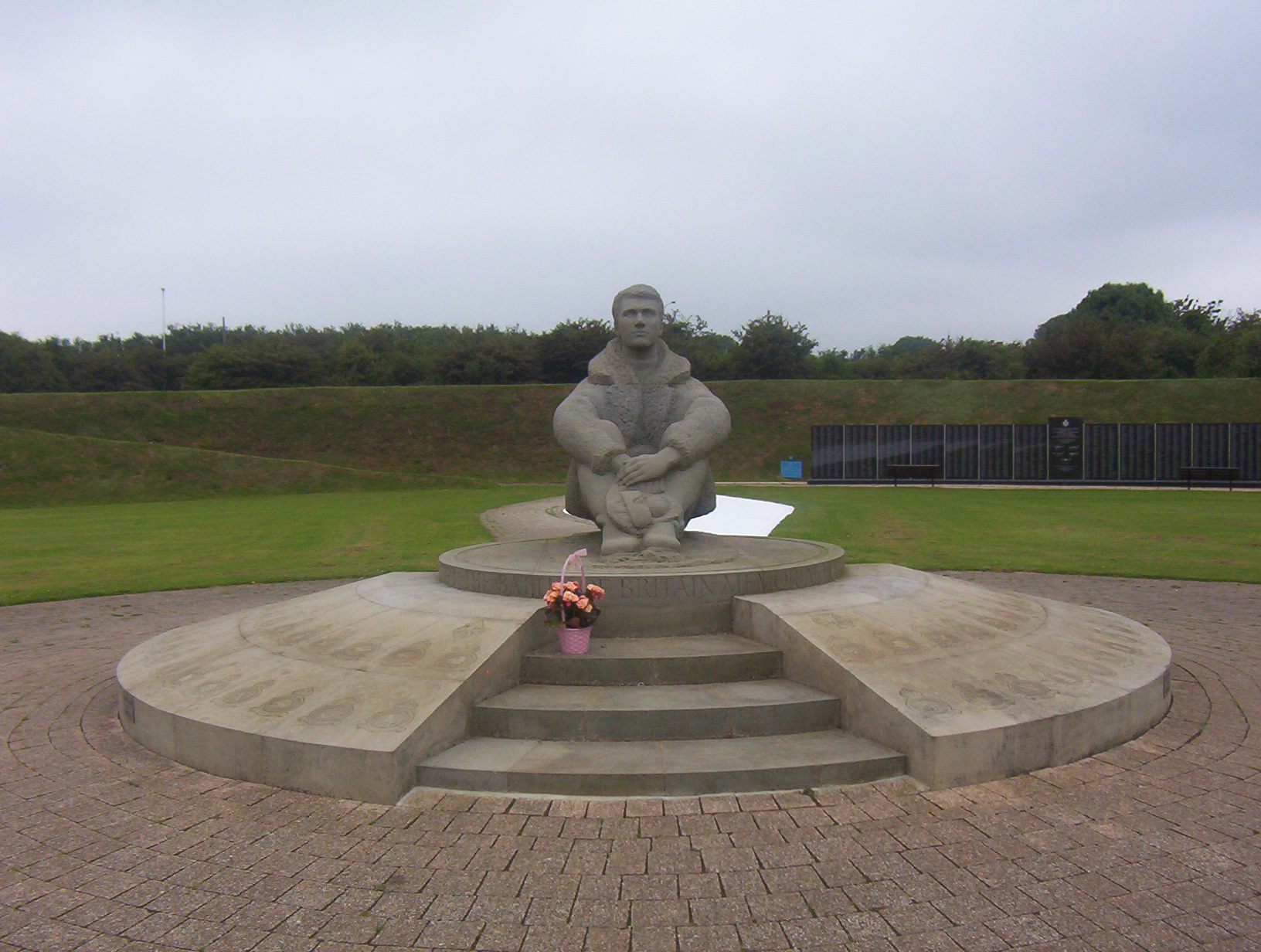
                                        Statue of seated pilot at the Battle of Britain Memorial Capel-le-Ferne, Kent UK
                                        Shared by Detraymond via Wikpedia Creative Commons Licence


I have been aiming  to write about how World War 2 has been covered  in contemporary song lyrics. There is of course a debate whether or not song lyrics can be defined as 'poetry' and I am not going to attempt to resolve this.

Anyhow. one track I have recently discovered is 'Capel-Le- Ferne' by Sussex singer songwriter, Greg Harper from an album titled 'Well Spun Lies' , and is about a former Battle of Britain pilot reminiscing.Greg has kindly agreed to allow me to reproduce the lyrics in full.

CAPEL-LE-FERNE

I remember that summer a long time ago
The waiting and the weather wondering if they’d show
Flying high over white cliffs over fields and sand
Looking down and protecting this green pleasant land

Now they ask was it exciting well you must’ve been so proud
A swooping and a soaring way up in the clouds
Mister how many did you get how many did you kill
But me I think of lost friends I’m thinking of them still

But if you ask me I’ll tell you
It felt just like dancing
Dancing on air
A dance for survival
A dance of despair
A life on the edge
Living life to the full
For death or glory
Oh glory so cruel

So I stand on the white cliffs at Capel-le-Ferne
There’s a band and a fly past how the years have flown
As I stand in the crowd there I feel so alone
Well the few they get fewer and soon we’ll be gone

But if you ask me I’ll tell you
It felt just like dancing
Dancing on air
A dance for survival
A dance of despair
A life on the edge
Living life to the full
For death or glory
Oh glory so cruel


Works well both as a poem and a song. I asked Greg via email for further background to the song:

"At the beginning of July 2010 I visited the Battle Of Britain memorial site at Capel-le-Ferne, Kent. It was just a couple of days before the annual ceremony, which is held to mark and remember the start of the battle. As I stood there on the cliff edge looking towards France, I tried to imagine what the remaining members of the Few might be thinking each time they attended the event over the years. What thoughts did they have as the dignitaries spoke, as the band played and the flypast went over their heads? My song Capel-le-Ferne is what I imagine they might have been thinking, on that day, and maybe every other day for the preceding 70 years. Now in March 2020, 10 more years on, only two of them remain "

To hear the track on line go to Greg Harper Music Audio webpage  and look for the 'Well Spun Lies' album. 'Well Spun Lies' also features another superb track relating to World War 2,  'November Sky,' about the bombing of Coventry on 14th November 1940.

Links

Greg Harper's website

Youtube video of the track 'Capel-Le-Feme'

Other blogs by Michael Bully

Bleak Chesney Wold Charles Dickens/ 'dark' Victoriana launched February 2023 

13th century history

A Burnt Ship  ( Poetry and other writing relating to 17th century warfare)


World War 2 Poetry blog supports the Second World War Experience Centre  Please consider looking at their website and the SWWEC Youtube Channel 
Sunday, 26 January 2020

Holocaust Memorial Day 2020


                 I felt that something had ended for Mankind

“I felt that something had forever ended for me and for mankind,” Różewicz wrote, “something that neither religion nor science nor art had succeeded in protecting"


                                          Hungarian Jews arriving at Auschwitz 1944
                                                        In public domain ,courtesy of Wikipedia 


In 1949, the German critic Theodor Adorno wrote the famous line ' After Auschwitz it is barbaric to write poetry' . The notion that the catastrophic impact of World War 2 was simply beyond poetry had been considered in such poems as Dylan Thomas' 'Refusal to mourn the death of a child by fire in London'.

"The majesty and burning of the child's death
  I shall not murder
  The mankind of her going with a grave truth
  Nor blaspheme down the stations of her breath
  With any further
  Elegy of Innocence and Youth. "

It's almost as if Dylan Thomas thought  that trying to write poetry about the death of a child in an air raid could not be done, in fact would debase the tragedy. Adorno went one step further using the term 'barbaric' . Yet Polish poet Tadeuzs Rozewicz (1921- 2014)  , who lived through the German occupation of Poland took an opposite view -"What I have produced is poetry for the horror stricken . For those abandoned to butchery . For survivors. " The view seems to be that writing holocaust poetry is somehow an act of human empathy, trying to acknowledge the suffering of those who perished or survived, carrying their trauma with them..  German Jewish poet Nelly Sachs, who managed to escape to Sweden and survive the War seemed driven to write about the Holocaust as if she had no other option  . Her famous poem 'The Chorus of the Rescued'   has the line " The worms of fear still feed upon us", as in being rescued she was committed to feelings of 'survivors guilt'  and grief for all those she knew who  failed to escape. ; more on Nelly Sachs can be found on a previous post.

To return to Rozewicz  it is worth noting that besides being a poet, he was also a playwright, translator of Hungarian poetry, screenwriter and novelist. During World War 2 he served in the Polish Home Army.  In his poem 'The survivor' ,Rozewicz  hinted that after the holocaust, language had lost the ability to make value judgement "Virtue and crime weigh the same" .  Yet from accounts of people who have visited Auschwitz , seeing possessions of prisoners can generate strong response. Can be a pile of shoes, a pair of glasses, knowing that their owners were systematically murdered. Rozewicz seemed to find such feelings in his poem 'Pigtail'

"When all the women in the transport
had their heads shaved
four workmen with brooms made of birch twigs
swept up
and gathered up the hair

Behind clean glass
the stiff hair lies
of those suffocated in gas chambers
there are pins and side combs
in this hair

The hair is not shot through with light
is not parted by the breeze
is not touched by any hand or rain or lips

In huge chests
clouds of dry hair
of those suffocated
and a faded plait
a pigtail with a ribbon
pulled at school
by naughty boys "

The Museum, Auschwitz, 1948
Translated by Adam Czerniawski 

Seems that Rozewicz found the language to write about Auschwitz but thought out his time as a poet could never write about beauty.

SOURCES

'Pigtail' is taken from 'Second World War Poems' chosen by Hugh Naughton, Faber and Faber 2004

Opening Quote by Rozewicz from review of his collected works Sobbing Superpower

Quote by Adorno taken from the introduction to  'Holocaust Poetry ' anthology edited by Hilda Schiff

Culture Poland website   English language page on Rozewicz is essential reading

Pigtails Poem read in English   with animation  on You Tube uploaded 2009  by 'Dawid'.

OTHER NOTES

 Currently working on Bleak Chesney Wold  Charles Dickens/ 'dark' Victoriana bog launched February 2023


UPDATE 2025 

World War 2 Poetry blog supports the Second World War Experience Centre  Please consider looking at their website and the SWWEC Youtube Channel 

World War 2 Poetry blog welcomes the new War Poetry Review website run by the War Poets Association


Friday, 29 November 2019

Alan Ross extract One


Alan Ross The Making of a Poet 


photograph FL 2837 from the collections of the Imperial War Museums (collection no. 8308-29) in the Public Domain , courtesy of Wikipedia and the IWM. 

In various blog posts I have written about the 'War at Sea' poetry of Alan Ross ( 1922- 2001)  and am hoping to transform various fragments into a longer study. One disadvantage is that I have not been able to trace the copyright holder to his work. Please get in contact if you  know who they are. 

Th work of Alan Ross falls broadly into three categories, War, Cricket and his Indian childhood. Ross was born in Calcutta, was sent to school in England at the age of seven,though returned to India regularly until 1937.  He was educated at  Haileybury and then St John's College, Oxford joining the Royal Navy on his 20th birthday in 1942. Ross began his war service as an Ordinary Rating on the lower decks, on board destroyers, serving in an Arctic Convoy, then the North Sea. After two years Ross joined the staff of the 16th Destroyer Flotilla, later to become an Intelligence Officer.

Already getting published during World War 2 simply by sending poetry to magazines and anthologies- John Lehman was the first to publish him in 'Penguin New Writing. Lehman introduced Ross to a circle of writers and painters, and also to Osbert Sitwell. Ross was later to recall arriving in his sailor's uniform to attend a Sitwell soiree and having a quick conversation on the stairs with a man wearing a raincoat who was just leaving , who turned out to be E M Foster.

 Once demobbed Alan Ross became a travel writer, cricket corespondent, magazine  editor, author, and carried on writing poetry. Immersed in the charming  literary world of the second half of the 20th century, his autobiographical writing is fragmented :Accounts of Alan Ross' naval service and its immediate aftermath can be found in his autobiographical 'Blindfold Games (1986); The book's title is from Rudyard Kipling's poem 'Tin Fish'
"They play their grisly blindfold games
in little boxes made of tin."

One neglected collection of literary work that was published during Word War 2 is the 'Transformation' anthologies edited by Stefan Schimanski and Henry Treece. 'Transformation 2' (1944)  listed contributors included poet and art critic Herbert Read, educationalist A.S.Neil. Richard Church, Stephen Spender, Morwenna Donnelly.....Henry Miller was the most well know writer. And an Alan Ross poem 'Waterfront' was included therein. The poem is not particular inspiring, a dreary description of humdrum port life being portrayed as some sort of awkward metaphor for a wider social malaise. Thankfully was not re-published. On the back cover of 'Transformations '  Ross was acknowledged 

Was born in 1918 and educated in India and Oxford. He is now serving in a destroyer' 

Ross was in fact born in 1922.  He was serving,as we have seen as an Ordinary Rating and  now being published alongside Spender and Read. Certainly an achievement for a 'War at Sea' poet. 


Alan Ross reflected on his attitude to War in 1975 in the introduction to a collection of his past poetry 'Open Sea'

"Reading the poems again, I am aware that they show no particular distaste for, or reaction against, the idea of war. They simply assume its particular necessity, an attitude I neither questioned at the time nor do now. The boredom, the misery and the waste were part of a larger experience that remains in many incidents, as vivid to me as when it took place."

 Ross went on to say

"I can think of no one I served with who resented the reasons for the war against Nazi Germany, however intolerable they may have found the reality."

I think it is the great American scholar Elizabeth Vaniver who warned against the 'privileging of the anti-war voice' when looking at war poetry. Certainly Ross was to experience the full onslaught of war at the Battle of Barents Sea, at the age of 20, and write about it in an epic poem 'J.W.51B'

Another anthology of World War 2 writing is 'Leaves in the Storm- A book of Diaries' edited by Stefan Schimanski and Henry Treece' , published in 1947. Alan Ross contributed a prose extract titled Arctic Convoy , about his time on board HMS ONSLOW

"AM ENGAGING THE ENEMY. Sea tilts over the bows, the wake zig-zags fiercely, time is contracted, a pin point. Far on the starboard horizon, the convoy turns south; a smoke-screen is put up like a wall by a destroyer, spouting grey belches like a train. Suddenly orange  is flung from the port quarter, long lean tongues forked from the enemy's mouth, soundless, in shafts of belched colour like a bridge striving to reach out and across. Like whales flicking, spouts of silky water explode in plumes, soundless. Again the orange tongue unleashes itself, flashing in flamingo streams of flame. World is become electric, power-wrecked, three feathers of water explode across the smoke, a low driven note."

ENDS


World War 2 Poetry blog supports the Second World War Experience Centre  Please consider looking at their website and the SWWEC Youtube Channel 

Tuesday, 13 August 2019

Leon Zdzislaw Stroinski 1921- 1944 'Warsaw'

                   
                                     Leon Stroinski- Poet of the Warsaw Uprising 


     Monument of Warsaw Ghetto Uprising in Warsaw by Yair Haklai, courtesy of Creative Commons licence 
                                             

Leon Zdislaw Stroinski was born in Warsaw in 1921, and died  fighting in the Warsaw Uprising on 16th August 1944. A collection of his prose poetry was destroyed in the fighting. In 1963 a collection titled 'Okno' ( 'Window') was published, containing 9 poems, 11 prose poems, a short story, and two polemical pieces' , and republished in 1982.
This post, more than anything, is an appeal for further information about his work. Hugh Haughton in his 'Second World War Poems', ( Faber & Faber 2004) , featured the prose poem 'Warsaw' , translated by the poet  Adam Czerniawski , who was born in Poland in 1934,


                                                     Warsaw 

" During the building of the barricades, the Vistula, brimming with reflections of forests, birds and white roads line with poplars, rose at first like a mist, then like a stiff cover of a book.

          In its shade at dawn caretakers come out with huge frayed brooms to sweep up the the tears which have collected during the night and lie thickly in the streets.

            Already. the market women, extended to the edge of sunlight, recommend potatoes grown on graves.

         And on the horizon of the street, across the roar of grenades lying in the curves of cobblestones,the soul of the city has been moving for months.

      The reflection of her face, too difficult to comprehend, has left a trace on the twisted faces of ruins as on the handkerchief of St Veronica.

       Those who will cone in the far, far future wanting to decipher them, drawing their cold-blue hands across features taut like strings, and who with careless fingers will poke the moan of those dried up in crevices-
       will burst in prayer or blasphemy.

       Here my country has come together from decimated forests and villages turned into a dog's howl. It persists in the whisper of mechanised armour.

      We had to wait through so much blood and pathos in order to build from the silence of ruined monuments such a vault over a city of jazz and death.

      Now lemurs from Gothic temples are thick on roofs of trams and terrify insurance officials on their way home.

    The  dead wander beneath the pavements and pound on bucklers which give a hollow sound, while at evening in double rows of whispers they walk arm in arm with the living, and you can tell them part only by skilfully folded wings, which nevertheless stick out on their backs like humps.

    But in daytime huge stone capstans hum, and only around noon, when folk sit down to lunch and it's a bit quieter, can you hear more distinctly the heavy rhythmical tread of God's steel-shod boots. "

Translated by Adam Czerniawski, 'The Burning Forest -Modern Polish Poetry', 1988.
     
I have not  been able to trace the copyright holder of this poem- if anyone owns the right, please get in contact and would be delighted to give them all due credit. 

           Another poet who died during the 1944 Uprising was Krzystof Kamil Baczynski ( born 1921) who was killed fighting the Germans on 4th August 1944. Have not been able to find anything by him in English but Culture.Pl website has a fascinating page about his life, but no extracts from his poetry.
Anna Swir was a military nurse during the Uprising, and came within an hour of being executed but was spared, and lived until 1984. The Chicago based Poetry Foundation has a useful biographical page on her, and links to some of her poems.


World War 2 Poetry blog supports the Second World War Experience Centre  Please consider looking at their website and the SWWEC Youtube Channel 

Tuesday, 11 June 2019

Miklos Radnoti (1909 -1944)

                                               
    Miklos Radnoti -'Flame must rise above death and autumn'   


                                                      Miklos Radnoti in 1930, courtesy of Wikpedia.

                                                       Peace, Horror


                                         When I stepped out through the gate,it was just ten o'clock
                                         A baker stepped by on gleaming wheels, a song on his lips.
                                         A plane droning high overhead and the sun up, it was ten,
                                         And my dead sister came into my mind and with that they were all
                                         Flying above me-those whom I love and who are not alive-
                                         Darkly across the sky, a host of the silent dead.....
                                         Then a jolt, and a shadow crumpled against the wall.
                                         Silence. The morning came to a halt on the stroke of ten;
                                         Hovering over the street- and a certain horror.   (1938)


                                Miklos Radnoti was born into a Hungarian Jewish family in 1909 .Radnoti's first collection of poetry 'Pagan Invocation' , was published in 1930. Two others followed in 1931, and 1933. In 1934 Radnoti moved to Budapest and started writing for a literary magazine titled Nyugat . Cultural life in Hungry began to reflect contemporary cultural tensions, Radnoti was firmly aligned with the more Left-leaning writers and artists of the day whilst German economic domination and political influence was growing.  Radnoti still had collections of poetry published and married his school sweetheart Fanni Gyarmati, and a lot of his poetry was inspired by her.

A fair amount of his poetry featured eerie premonition of what calamity was going to befall Hungary. Radnoti avidly followed the Republican cause in Spain. In 1936 he brought out a collection titled ' Keep Walking, you the Death Condemned' . The poem of the same name was also a strange premonition of Radnoti's own fate
                           
                                       "Keep walking, you, the death-condemned'
                                         In front, the dark trees ranged in line
                                         Topple towards you; bushes hide
                                         A cat and the chill wind. The road
                                        Turns white with fear, arching its spine.
                                   
                                        Shrivel away now, autumn leaves!
                                        Shrivel, oh terrifying world!
                                        Cold hissing from the sky is harsh,
                                        And on stiff, rusty blades of grass
                                        The shadows of wild ducks are hurled ....."


A series of repressive measures were passed in Hungary from 1930- 1941, instigated by Admiral Horthy's regime.  Types of employment were banned to Radnoti as a Jew , but worst was the fact that Jews were forced to register to join a forced labour system. Hungary became more aligned with the Axis, even declaring war on the Soviet Union in 1941, and sending troops to take part in the invasion.  Radnoti was called up for three months in 1940 for labour service, and for ten months in 1942-1943 Shortly after this term, Radnoti converted to the Roman Catholic faith. In 1944 he was deported to Yugoslavia to serve with other Jews in  building  roads for the German occupiers. By then Germany had assumed control of Hungary.

In September 1944, the Germans had to evacuate the Balkans following the advance of the Red Army and the growing confidence of Tito's partisans. The Hungarian Jewish labourers,who were partly guarded by Hungarian soldiers,  were made to join a forced march back into Hungary. Cold weather, near starvation, damaged health, and exhaustion led to many casualties. Around the 8th November 1944 , near the town of Gyor, Radnoti was amongst 21 sick and exhausted  Jewish labourers who were separated from the main column. The following day, near the town of Abda, the Jews were made to dig a ditch, then shot one by one.

After the War, the bodies were exhumed. It was discovered that Radnoti had hidden a notebook of his poetry in his coat. In 1948, a posthumous collection of poetry was published.

Ultimately Radnoti's work was inspired by Jewish culture, with a growing Christian influence, Anti-Fascism, reverence for nature, an instinctive humanitarian viewpoint, with a haunting fatalism. A feeling that however hopeless his predicament must have seen as a Jew with liberal-Left views,  trapped in central Europe dominated by the Axis, Radnoti was never going to  abandon his idealism.

However harrowing Radnoti's war poetry could be, thought that it was fitting to end with some lines that showed that Radnoti was poet who wrote about love. And this must not be forgotten. Here are  the final three verses of 'Autumn Begins Restlessly'... written in August- September 1941.

                                     
                                                    " The landscape falls asleep
                                                     Death lovely in his white glide
                                                     Settle on the countryside.
                                                     The sky cradles the garden.
                                                     Look; in your hair's and autumn leaf that's golden,
                                                     Above you, branches weep.

                                                    Ah but your flame must rise above death and autumn
                                                    And raise me love, love, along with you.
                                                    let the wise thing be to love me today-
                                                    Be wise and kiss me, hungry for dreams too.

                                                   Joyfully love me, do not leave me, fall
                                                   With me into the dark sky sleep creates.
                                                   Let's sleep. Out there the thrush is well asleep.
                                                   The walnut, falling on fallen leave piled deep,
                                                   makes no harsh sound. Reason disintegrates."


Sources

Poetry

Some English translations of Radnoti

Dame Judi Dench  reciting Miklos Radnoti poem  from (Exiled Hungarian ) director Robert Vas'  film 'My Homeland' from 'Youtube'.


Books 

'Foamy Sky- The Major Poems of Miklos Radnoti' Selected by Zsusanna Ozsvatha and Fredrick Turner, , Princeton University Press, 1992 is highly recommended. A superb collection of Radnoti's work from 1929- 1944 with a useful biography.

'Forced March-Selected Poems' by Miklos Radnoti, Translated from the Hungarian by Clive Wilmer and George Gomori. , Enitharmon Press , in association with the European Jewish Society, 2003. Also recommended...shorter collection than 1992's 'Foamy Sky' and a great introduction to Radnoti's life and work.

Fanni Gyamati died on 15th September 2014.  The Daily Telegraph Obituary is well worth a read.

Other blogs :

Bleak Chesney Wold   19th century history & literature blog

A Burnt Ship                17th century history warfare & literature blog 

Contact: Michael Bully     World War 2 Poetry@mail.com   ( please ram words together without spaces) 


Social Media 

Threads

MrBleak5

Mastadon 

Michael@BleakChesneyWold

Instagram  

Mr Bleak (@MrBleak5 )